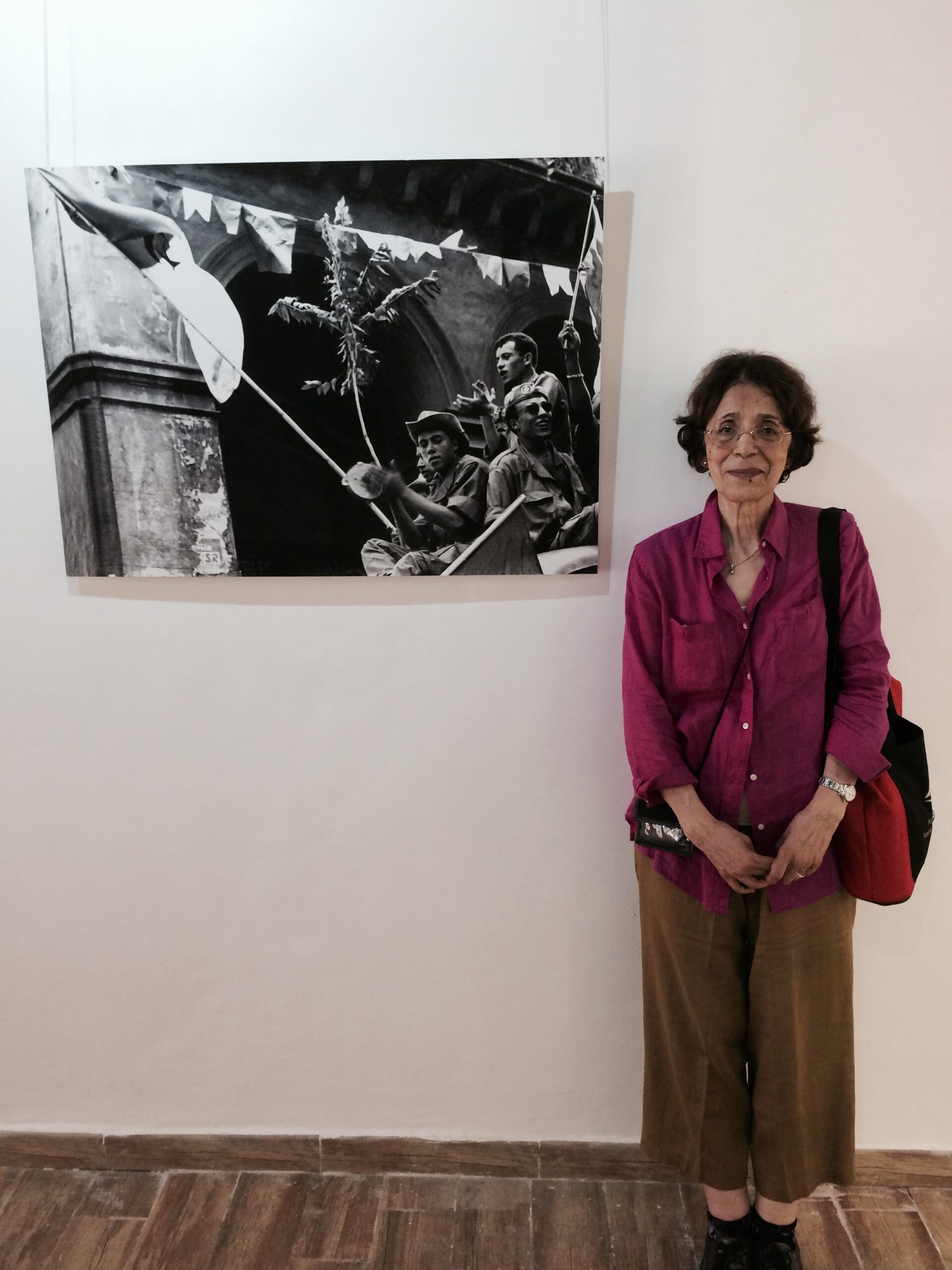
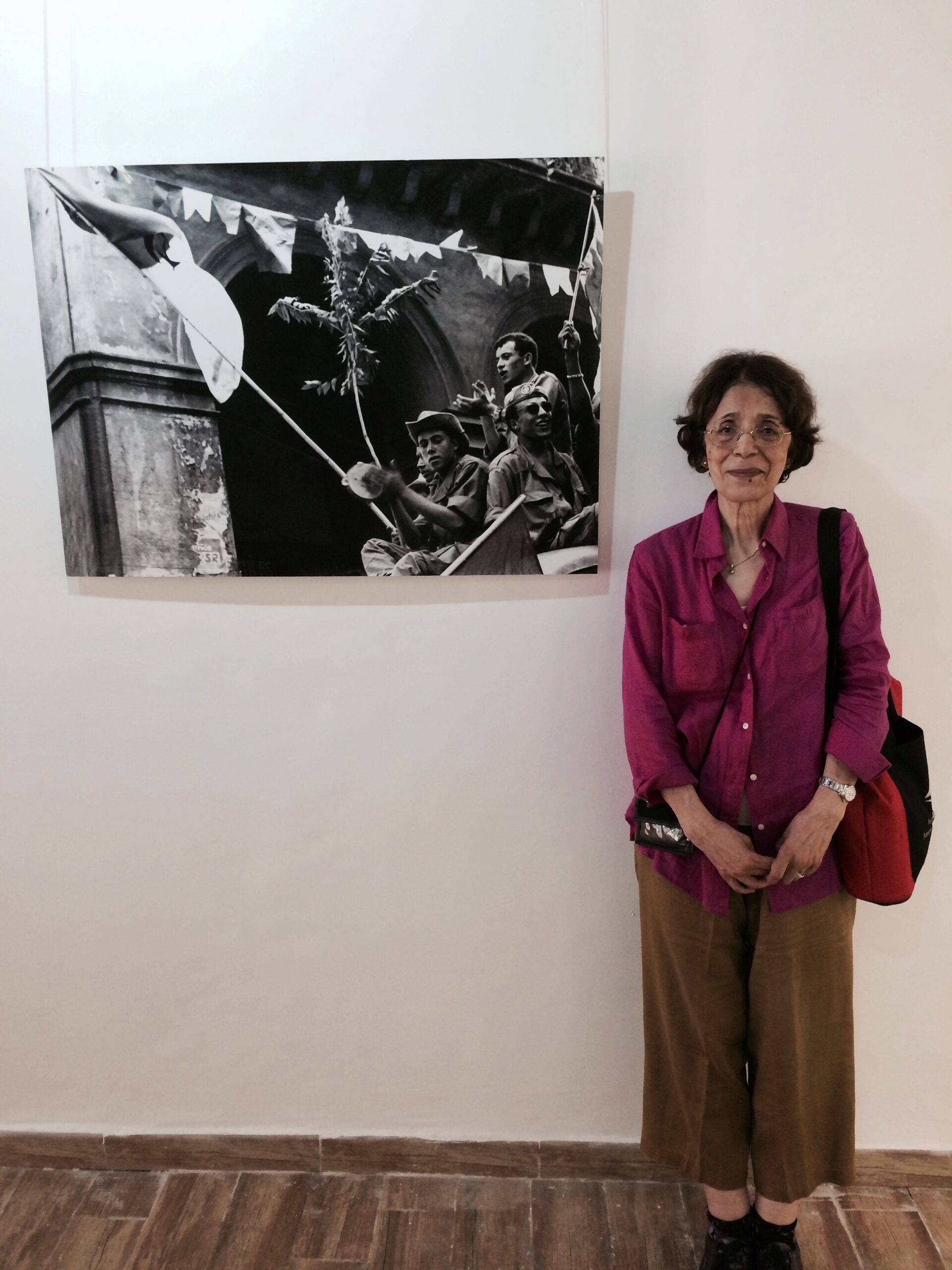
Marnia Lazreg was an historical sociologist who made fundamental contributions to a wide variety of fields, including the study of women, Foucault, torture, and France’s colonization of her native Algeria. She was possibly the only Algerian woman of the pre-independence generation to obtain a PhD in the United States and pursue an academic career there, publishing academic work exclusively in English for more than fifty years. She was also a novelist.
Events
Conference
Women, Algeria, Torture, Foucault: Advancing the Anticolonial Sociology of Marnia Lazreg
September 25-26, 2025 @ The Graduate Center of the City University of New York and Roosevelt House Public Policy Institute at Hunter College.
The conference will bring together scholars from a variety of disciplines and locales to build upon ideas that Marnia expounded in her five most recent books. More at the conference website.
Memorial
Celebrating Marnia Lazreg
[This event has passed.] May 30, 2024 @ 45 Rockefeller Plaza
We celebrated the life of Marnia Lazreg. Select video and text of tributes delivered at the event can be found here.
Obituaries
The Washington Post
“She ranked among the most respected academic voices on women’s affairs in North Africa and helped expand Arab viewpoints in Western feminist scholarship.”
The New York Times
“Lazreg’s books were unusual because she herself was unusual: an Algerian-born scholar . . . who was based in America and who wrote in English from a feminist, anticolonial perspective.”
El Moudjahid
“Elle a démontré, dans le cadre de ses investigations, que les femmes musulmanes ne sont pas simplement des sujets passifs, mais des actrices essentielles dans la construction de leur société.”
The Graduate Center, CUNY
Marnia was a “pathbreaking historical sociologist who made fundamental contributions to a wide variety of fields, including international development, second-wave feminism, torture, colonialism, Islam, and Foucault studies.”
Hunter College, CUNY
A “trailblazing . . . Sociology professor” and “gifted theorist”.
El Khabar
مغنية لزرق.. نجمة ساطعة في الأدب والفكر والعلم
Marnia’s Books
Classes / Women / Torture / the Veil / Foucault / Islamic Feminism
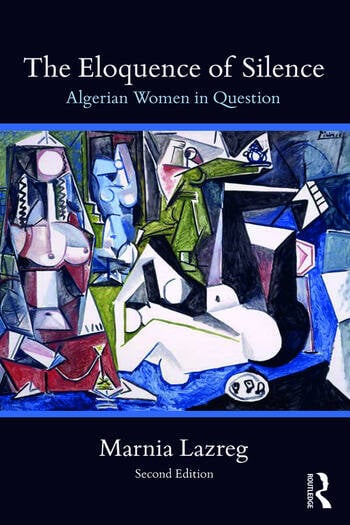
The Eloquence of Silence:
Algerian Women in Question
(1994)
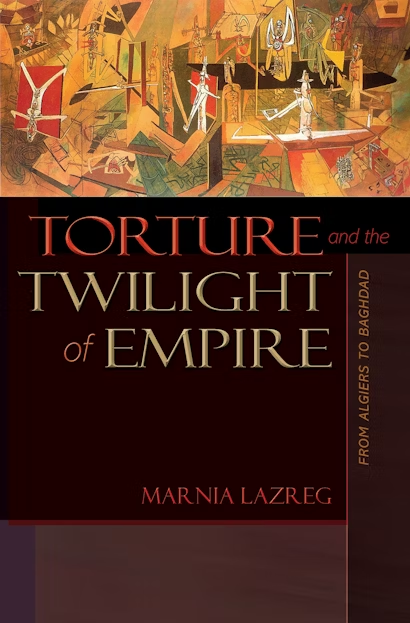
Torture and the Twilight of Empire:
From Algiers to Baghdad
(2008)
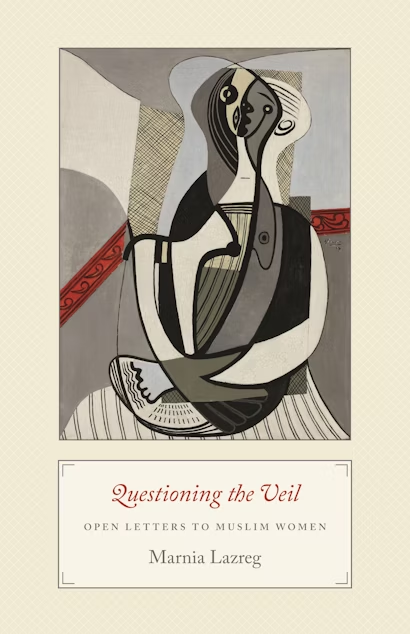
Questioning the Veil:
Open Letters to Muslim Women
(2011)
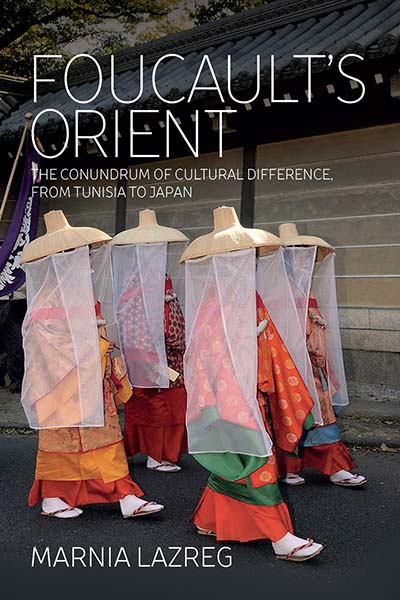
Foucault’s Orient:
The Conundrum of Cultural Difference, From Tunisia to Japan
(2017)
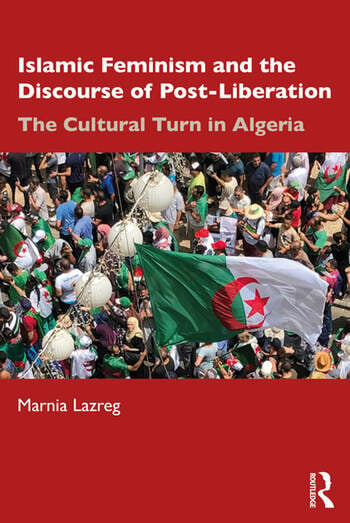
Islamic Feminism and the Discourse of Post-Liberation:
The Cultural Turn in Algeria
(2021)
“My work reflects my horror of dogma, be it theoretical, methodological or political.”
Marnia Lazreg
Marnia’s Intellectual Journey in Her Own Words
Lazreg, M. (2020). Carving Out a Space for Critical Writing. Journal of World Philosophies, 5(2), 139–144.
My intellectual journey is to a large extent intertwined with the history of the country I was born in, Algeria. Always complicated and at times confusing, it is a history of might that makes right, of a simmering search for the right to be, of the right to speak, and the right to be heard. What would be the trace left in my approach to sociology by the little girl growing up in a land of divisions and contrasts, symbolic and real? Her childhood was framed by vestiges of the remote past and the massive presence of a new order. On one side, the ruins of an Ottoman fort with its rusted iron gates that enclosed the old town, which French colonists called the “native quarter” or the “Arab quarter”; on the other side, the white-washed mausoleum of Sidi Saïd, the patron saint of the city, who stood guard next to the colonial Town Hall, in a demure and puny defiance of the monumental church triumphantly erected a few feet away right in the center of the city. Even nature seemed to conspire to keep the natives’ town separated from the French town by conjuring up a river, colorfully named the Yellow Spring, Aïn Sefra, which made going to the French quarter—ironically called El Bled (which, although understood to mean the city center in Arabic, also meant the “countryside”)—a crossing. The girl crossed the Yellow River thousands of times over a period of 12 years, from grade school to the lycée and back.
Crossing over to acquire knowledge was an essential part of her growing up. Hence, river crossing and crossing over to the unknown in order to know is not just a metaphor, but an essential part of my intellectual outlook. Knowledge is a crossing over from the comfort of one’s familial environment to one that is different, unsettling, and requiring an active work of pondering, sifting through, often without coming up with answers, but always keeping an open mind for some ever-receding resolution. For me, crossing over the arbitrary colonial divide in search of knowledge was compounded by the search for truth. To what extent did the colonial condition, especially during the war of decolonization (1954-62) in which I grew up, provide the test of the truthfulness of the knowledge I was acquiring by crossing the river? My colonial education was blind to my history, to the reality of war, and most of all to itself. It never questioned itself; it lived in the illusion of its absolute perfection, which it strenuously imparted to students.
One lycée experience stands out in my mind as leaving an indelible mark. In retrospect, it was a harbinger of things to come in my adulthood. In a philosophy class library intended to encourage reading, in the midst of the war raging around me, I took out Albert Camus’ L’homme révolté (The Rebel). After wading through a description of various phases of revolt, I came upon an emphatic statement that revolution can only occur in the west! I was astonished, disappointed, and felt a deep despair. I did not understand why this was so. Were the deaths or arrests of the people reported in the daily papers (which I started reading at an early age) meaningless? The title of the book held the promise of helping me make sense of the war. Instead, it crushed my spirits. Where did the war I was living through fit in the idea of the “west,” which Camus graced with the monopoly over revolution? To add to my disarray, the philosophy professor surprisingly asked me in front of the class why I had not used the book in my composition, for which it was not required? “Yet you do not lack for intelligence,” he added. How could I have used the book? It had silenced me. It did not speak to me; it spoke against me. That sense of being stifled by the power of constituted knowledge, deemed unquestionable, was unbearable. In retrospect, the professor must have been secretly pleased that I selected that book, which no one in the class had read, and was genuinely interested in my reaction to it even though it had not been assigned. I gave none. What could I have offered as a rejoinder except the experience of a colonized girl in a politically hostile environment that supported Camus’s view?
Colonial history is only one history that framed my formative years. The end of colonial domination (in July 1962) itself was a historic event. Indeed, I crossed over again into the independence of a new nation, experiencing the elation of being free, and later crossed the Atlantic Ocean to acquire a different kind of knowledge in the United States of America. Hence Algeria as subsumed under France, Algeria as free, the United States as the new home away from home are the crucible out of which I emerged as a person writing about power, gender, and history. I tried to build an intellectual house, which would at once combine a love of learning, an indomitable freedom to be critical, a diffident attitude towards the cult of intellectual personalities, and a staunch resistance to intellectual fads. This house serves as a refuge to which I escape from attempts at fixing my identity, or academic pressures to go with the flow.
The United States, the country from which I write, meant at first the stark realization that the system based on separation, domination, and willed inequities I grew up in was hardly unique, or the preserve of colonial empires. The Civil Rights Movement, periodic riots in Harlem in the summer, the anti-war movement, the Black Panthers, the birth of second-wave feminism—all these events are so many markers of my early life in New York. The protests for civil rights echoed those of the Algeria I grew up in, and brought home to me the universality not only of the struggle for freedom and dignity, but also of the suffering caused by power and domination when left unchecked. What I took to be a unique experience of powerlessness was in fact shared by so many others in a country that was not colonized, but a successful colony in its own right, which also silenced its own “natives” and minorities, inside and outside of the academy.
I wanted to understand the interface between the history of the present as it unfolds and the history I lived that seemed to replay itself in a new environment. Where are you from? This question, which shadowed me wherever I went (it still does to a lesser degree), and which is never satisfied with a one-word answer, had the benefit of compelling me to strive to understand the society I came from better. However, this turned out to be a struggle. Indeed, the field I had chosen, sociology, raised all sorts of problems for me. First, I realized how normative it was. From the start, I had doubts about the degree to which the lectures I attended could account for the socio-historical issues that occupied my mind. I even doubted whether they helped me to understand the American Black family, which at the time was defined as a “problem” by sociologists as well as politicians who abstracted it from the political economy of race.
As a graduate student at NYU, I felt disempowered. I learned quantitative methods in the naïve belief that they could be the solution to my quandaries. For my master’s thesis, I studied “job satisfaction” in an Algerian state-owned company. This was an honest exercise in the application of what I had learned, which nevertheless left me hungering for answers to the bigger questions: Why does knowledge of the Third World flow mostly from Europe and North America? What is the effect of colonial rule on the political and economic systems established in the postcolonial era? What is the relationship between the knowledge system that supported colonial domination and the one I was acquiring in my sociology classes now? Why was it considered presumptuous for a graduate student from the “Third World” to intimate that Weber or Durkheim, or any other social theorist, could have gotten some things wrong? Intellectual compliance with the canon was de rigueur. Weber was unimpeachable, yet I could not accept professors’ fascination and even smug satisfaction with his stress on the uniqueness of the west, and its world universality. I had no counter-knowledge on which to draw. My intellectual referent points were all French-colonial. I only had my experience of a history of domination and resistance. Yet, I also appreciated Weber’s method of verstehen. But it did not seem to lead to a better understanding of cultural difference. Nevertheless, I preferred it to Durkheim’s unbridled positivism, or Parsons’s arid social system. I am glad in retrospect that I had not yet read Weber’s uninformed conception of Islam, and that no one mentioned it in my classes. However, Weber sensitized me to the importance of historical sociology, which suited me far better than quantitative sociology.
There were few courses offered in the sociology department at NYU that resonated with my interests. I searched for marginalized authors and fields that lent themselves to contentious debates, or in which I could think outside of the box. I explored the “sociology of the absurd,” social psychology as well as symbolic interactionism. Erving Goffman’s Asylums and the Presentation of Self in Everyday Life resonated with me. Through Goffman, I realized the complexity of American culture, and wondered whether I had a feel for the game in many situations. Ironically, I read Fanon in New York for a class offered by a “radical” criminology professor. Fanon’s depiction of the psychic effects of the colonial system on the colonized echoed my experiential knowledge of life as a colonized girl. But it was a confirmation of experience, not its overcoming. Then one day, a newly hired German-American professor lectured about Marx. I felt empowered. Finally, we could discuss alienation, surplus labor as exploitation, imperialism! Marx’s analysis of the logic as well as phenomenology of capitalism helped me to situate colonial domination in a global economic as well as cultural framework. From Marx I worked my way back to Hegel. However, in spite of the uplifting effect they had on me, these and other academically marginalized voices still did not answer my queries about the hegemonic character of knowledge production, be it sociological or historical. If imperialism, of which I am an outcome, is analyzed by Marxists as a (necessary) stage of the development of capitalism, had I been doomed to be colonized? I needed to carve out a path for myself that would enable me to express my profound skepticism about constituted sociological knowledge, with its nineteenth-century European social presuppositions and claims to scienticity.
In pursuit of this goal, I explored a number of authors, including Freud’s psychoanalytic theory; the Frankfurt School critical theory; Sartre’s reading of Marx; Wallerstein’s and Johan Galtung’s world systems theory; and for a while delved into ethnomethodology. Unexpectedly, ethnomethodology gave me a handle on how knowledge is constructed from the ground up. The manner in which social scientists translate their observations of behavior actually changes the observation itself. The behavior as analyzed is not the same as the behavior observed. If this happens to behavior in a social environment familiar to the social scientist, it must be even more so in a culture different from that of the observer. It is not that this issue was unknown to scholars other than Harold Garfinkel, the practitioner of ethnomethodology. Peter Berger, among others, had already studied the social construction of reality. But, in extrapolating from Garfinkel, I understood that the transformation of reality as observed, especially in a different cultural environment, leaves the original experience unexplained. In other words, there is a residual experience that escapes theoretical concepts elaborated to account for one historically specific reality when applied to a culturally different one.
This background, existential as well as intellectual, is reflected in facets of my work. If my research focus shifted depending on events, my subject matter never did. I have an abiding interest in Algeria, which has fascinated me not only because of its complexity, or its cultural specificity, but also because of the theoretical challenge its poses to the researcher: it rarely fits our pre-formed concepts or accepted generalizations. Writing about Algeria is an endless discovery of a history I was never taught. Thinking I would come to terms with the colonial legacy, I first studied the emergence of social classes in the aftermath of the war of decolonization in Algeria. I hid behind academic neutrality, while searching for signs of a re-composition of classes once colonial rule formally ended. Finding inspiration in a publication by a Yugoslav theorist critical of communism, Milovan Djilas’s “The New Class,” I argued that socialism in Algeria was producing classes which in the long run would emancipate themselves from their dependency on the state. Curious about the rise of identity politics, I briefly studied the Berberist construction of cultural difference—a topic I am still collecting data on. It was not until I encountered American feminist thought thanks to two fellowships, and interacted with a number of feminists, that I discovered my voice. The initial academic feminist critique of constituted knowledge in its search for a de-centered, liberatory knowledge resonated deeply with me. This indeed was also the goal I had been groping for. However, I soon became disenchanted with academic feminism’s ambition to define women such as myself, who hailed from the Middle East and North Africa, as “oppressed,” passive bearers of religious categories, and in need of liberation. Social science knowledge-as-usual was being reproduced by the very women who claimed to de-center it. I subsequently started to write in the first person as an act of resistance to the feminist epistemic power over “Muslim” women. The article, “Feminism and Difference: The Perils of Writing as a Woman on Women in Algeria,” first expressed my theoretical misgivings about the feminist construction of the Muslim difference. I subsequently attempted to restore to these “oppressed” women their share of human dignity by stressing their unrecognized struggles against the very system which academic feminisms had passed under silence: colonial domination and colonial knowledge—a chain that linked together systems of ideas, including those presented as liberating, which needed to be acknowledged and remedied. Silencing the global power context within which academic feminist thought emerged also meant silencing “Muslim” women. Hence the book, The Eloquence of Silence: Algerian Women in Question. Still, to its credit, second-wave feminism made me realize the power of the “I,” of writing in the first person, and of being conscious of self-positionality. The message I retained is that speaking one’s truth, when it goes against the (new) canon, is valuable to the self, to others, and to the advancement of a de-centered knowledge.
The “war on terror” revealed to me a shift of focus from the “oppression” of Muslim women to the sexual torture of Muslim men. Claiming anthropological knowledge of gender relations in the Middle East and North Africa, the prosecutors of this war adjusted their torture techniques accordingly in Guantanamo Bay (and the multitude of rendition sites around the world) as was done in Algeria decades before. The Algerian war scenario, which featured torture as a component part of military doctrine, was being replayed. Even the docudrama The Battle of Algiers was used in teaching urban guerilla warfare to American troops in Iraq and Afghanistan. The colonial logic was at work again, bringing together knowledge of women and of the cultures of the Middle East in a geopolitical strategy intended to remake the map of the region in the post-Cold War era. I wrote Torture and the Twilight of Empire, from Algiers to Baghdad to demonstrate the continuity in methods used by France in its colonial imperial war to keep Algerians subjugated and the United States’ neo-colonial, pre-emptive wars in the Middle East.
From the study of torture as a trope through which to understand unequal knowledge and unequal power, I shifted to an analysis of the process through which critical academic knowledge of western rationality is constructed on the exclusion of non-western rationality. Michel Foucault’s work gave me the opportunity to understand how, even when critical of itself, western thought understands itself in opposition to non-western thought. In Foucault’s Orient: The Conundrum of Cultural Difference, From Tunisia to Japan, I traced Foucault’s definition of the “Orient” as a limit experience of western Reason. This was a deliberate choice he made to analyze the specificity-qua-universality of the western ratio as uniquely equipped to capture an order in the world. By the same token, the book enabled me to identify the limitations of Foucault’s anti-humanist posture, which critiques the failures of humanism but falls back on its presuppositions when needed.
Whether reflecting on feminist theory or Foucault’s thought (which made inroads in academic feminism), I could not ignore an ascendant culturalist trend in scholarship. Once defined as oppressed, “Muslim” women have emerged in the past two decades as heroines of a movement intended to bring about change in gender relations through Islam. Hailed as liberatory, a trend in Islamic feminism (which I refer to as Quranic attributor contextualism) claims to be the only alternative to “secular” feminism. This trend was an opportunity for me to analyze the unrecognized effect of a postfeminist culturalist bias on Islamic feminism. The postfeminist retreat from the universality of freedom and its flaunting of cultural difference plays a legitimating function in the reception of Islamic feminism. More importantly, this trend enabled me to bring to light the role played by Islamic feminism in the cultural strategy of the “war on terror” of promoting a deradicalized, “moderate” Islam. Quranic attributor contextualists’ advocacy of a “progressive” Islam coincides with, and is supported by, the state’s deradicalization policy as defined in the doctrine of the “war on terror.” My next book, Islamic Feminism and the Discourse of Post Liberation in the Middle East: The Cultural Turn in Algeria, questions the liberatory claims of the prevailing trend of Islamic feminism and calls for the demystification of its function in the “war on terror.”
Exploring the turn to culture alerted me to a special use of culture in discrediting the revolutionary character of movements of decolonization, such as Algeria’s. By the same token, invidious comparisons between postcolonial and colonial governments are harnessed insidiously to rehabilitate colonial rule as somehow emancipatory. I realized that the French Revolution was the paradigmatic model of revolution in this reconstruction of a crucial part of the history of contemporary Algeria. Yet the French Revolution, contested at home, gave birth to the Empire that also restored slavery to the first independent colonial nation, Haiti. Reading about the troubled history of Haiti revealed to me the role this nation played in the philosophy of Hegel as recounted by Susan Buck-Morss in Hegel, Haiti and Universal History.
With this research, I have come full circle. If Camus crushed my spirit in my teenage years, contemporary revisionists of the Algerian war find me speaking loudly. Silence is no longer possible. As I ponder my early reading of Hegel’s “Lordship and Bondage” in his Phenomenology of Mind in light of Buck-Morss’s book, and the return of Camus’s notion of revolution, I am struck by the resilience of disempowering systems of ideas. I am convinced that to achieve intellectual liberation requires an unwavering critical awareness of mystifying concepts, the will to challenge academic fads, the capacity to resist the seduction of ideas that comfort us in our own prejudices, and a constant self-examination.
Subscribe
Receive email updates on scholarship and events related to Marnia’s life and work.